May 6

The B+C|A Spring 2026 Independent Study Presentations

-
501, The Diana Center
  • Add to Calendar 2026-05-06 14:00:00 2026-05-06 16:00:00 The B+C|A Spring 2026 Independent Study Presentations All are invited to attend our Independent Study Presentations on Wednesday, May 6th, where students who pursued independent research during the spring semester will present their projects. These presentations are open to the entire community, and we especially encourage students considering applying for Independent Study in the future to attend. Twyla F. Bowen Island Sustainability Research and Education Hub This project proposes a multi-use educational center on Bowen Island that combines building design and curriculum to support place-based, interdisciplinary learning rooted in embodied ecological pedagogy and climate futures. By bridging the University of British Columbia and Island Discovery Learning Community, it addresses the island’s lack of a high school and the unsustainable commuter dynamic for professors and researchers, aiming to create a locally grounded, resilient intellectual and community hub. Sofiya B.  After Departure: A Performing Arts Commons in a Former Soviet Aerovokzal My project reimagines the former Aervokzal in Almaty, Kazakhstan, a part of Soviet mobility infrastructure, as a performing arts commons, transforming a building once dedicated to transit and control into one oriented towards informal modes of cultural and artistic expression. Originally conceived to efficiently process passengers through tightly choreographed sequences of movement, the aerovokzal aimed to minimize the time spent in the space. My project deliberately reverses this temporal logic by slowing the pace of the building and one's experience in it through performance, rehearsal, and gathering, allowing spaces once designed for departure to become ones of presence and a shared cultural life. Lowell C.  Appalachian Futures: Reinterpreting Andean Building Methods as a Framework for a New Rural Vernacular This independent study examines traditional Andean earthen construction methods—including wattle-and-daub, adobe, rammed earth, and sod block—as models for contemporary building. It proposes these techniques as a framework for developing affordable, sustainable, and participatory housing solutions in rural Appalachia. Lily K.  Redefining Museum Architecture: The Rise of Private Art Institutions in a Multipolar Era of Influence My thesis argues that the recent rise of privately funded contemporary art museums in Paris represents not a break in tradition, but an evolution of it. These institutions and their innovative architectural designs are reshaping Paris's urban and cultural landscape, redefining the balance between public national authority and private influence, ultimately causing Paris to act like a curated piece of art in itself.  Grace Z.  Methods of Representation: Piccola Casa Ideale Using Gio Ponti’s Piccola Casa Ideale as a controlled case study, this project examines how different modes of representation construct and limit and permit our understanding of interior and exterior space. Through iterative drawings and contextual research into material, site, and program, a final series of renders uncovers spatial, environmental, and experiential qualities that further explore what is articulated in Ponti’s original drawings.  Ardalan T.  Representing Architecture After AI My research investigates emerging AI representational systems through direct experimentation with tools such as 3D Gaussian Splatting and image-to-mesh reconstruction, examining how they transform architectural information and what forms of agency architects retain in shaping their development and use. Bringing these experiments into dialogue with architectural theories of representation, I examine the conditions under which these systems can be evaluated and situated within practice as representational instruments.  Isabella E.  Urban Insect How can the building think about bugs? How can we understand the implications of design decisions on the insect communities of the city? Sabrina S.  Memorializing Post-Atrocity Violence: Melinka-Puchuncaví Heritage Site in the Aftermath of the Pinochet Dictatorship This independent study project traces the material and architectural histories of Melinka-Puchuncaví, a clandestine detention center repurposed under the Pinochet Dictatorship from 1973-1976, and its transformation into a heritage site following the dictatorship’s collapse. The project critically addresses the ethical and human rights implications of Melinka-Puchuncavi’s restoration into a memorial site and argues that such architectural practices have meaningful consequences on the remembrance of those disappeared and tortured.  Aviya A.  Designing Beyond Earth: Foundations of Space Architecture “Earth is the cradle of humanity, but one cannot live in the cradle forever.” - Konstantin Tsiolkovsky This independent project examines the history, theory, and challenges of designing habitats for humans beyond Earth. Through interdisciplinary research and the study of speculative and real space architecture projects, I explore how architecture can support and shape human life in extreme environments.   501, The Diana Center Barnard College barnard-admin@digitalpulp.com America/New_York public

All are invited to attend our Independent Study Presentations on Wednesday, May 6th, where students who pursued independent research during the spring semester will present their projects. These presentations are open to the entire community, and we especially encourage students considering applying for Independent Study in the future to attend.

Twyla F.
Bowen Island Sustainability Research and Education Hub
This project proposes a multi-use educational center on Bowen Island that combines building design and curriculum to support place-based, interdisciplinary learning rooted in embodied ecological pedagogy and climate futures. By bridging the University of British Columbia and Island Discovery Learning Community, it addresses the island’s lack of a high school and the unsustainable commuter dynamic for professors and researchers, aiming to create a locally grounded, resilient intellectual and community hub.

Sofiya B. 
After Departure: A Performing Arts Commons in a Former Soviet Aerovokzal

My project reimagines the former Aervokzal in Almaty, Kazakhstan, a part of Soviet mobility infrastructure, as a performing arts commons, transforming a building once dedicated to transit and control into one oriented towards informal modes of cultural and artistic expression. Originally conceived to efficiently process passengers through tightly choreographed sequences of movement, the aerovokzal aimed to minimize the time spent in the space. My project deliberately reverses this temporal logic by slowing the pace of the building and one's experience in it through performance, rehearsal, and gathering, allowing spaces once designed for departure to become ones of presence and a shared cultural life.

Lowell C. 
Appalachian Futures: Reinterpreting Andean Building Methods as a Framework for a New Rural Vernacular
This independent study examines traditional Andean earthen construction methods—including wattle-and-daub, adobe, rammed earth, and sod block—as models for contemporary building. It proposes these techniques as a framework for developing affordable, sustainable, and participatory housing solutions in rural Appalachia.

Lily K. 
Redefining Museum Architecture: The Rise of Private Art Institutions in a Multipolar Era of Influence
My thesis argues that the recent rise of privately funded contemporary art museums in Paris represents not a break in tradition, but an evolution of it. These institutions and their innovative architectural designs are reshaping Paris's urban and cultural landscape, redefining the balance between public national authority and private influence, ultimately causing Paris to act like a curated piece of art in itself. 

Grace Z. 
Methods of Representation: Piccola Casa Ideale
Using Gio Ponti’s Piccola Casa Ideale as a controlled case study, this project examines how different modes of representation construct and limit and permit our understanding of interior and exterior space. Through iterative drawings and contextual research into material, site, and program, a final series of renders uncovers spatial, environmental, and experiential qualities that further explore what is articulated in Ponti’s original drawings. 

Ardalan T. 
Representing Architecture After AI

My research investigates emerging AI representational systems through direct experimentation with tools such as 3D Gaussian Splatting and image-to-mesh reconstruction, examining how they transform architectural information and what forms of agency architects retain in shaping their development and use. Bringing these experiments into dialogue with architectural theories of representation, I examine the conditions under which these systems can be evaluated and situated within practice as representational instruments. 

Isabella E. 
Urban Insect
How can the building think about bugs? How can we understand the implications of design decisions on the insect communities of the city?

Sabrina S. 
Memorializing Post-Atrocity Violence: Melinka-Puchuncaví Heritage Site in the Aftermath of the Pinochet Dictatorship
This independent study project traces the material and architectural histories of Melinka-Puchuncaví, a clandestine detention center repurposed under the Pinochet Dictatorship from 1973-1976, and its transformation into a heritage site following the dictatorship’s collapse. The project critically addresses the ethical and human rights implications of Melinka-Puchuncavi’s restoration into a memorial site and argues that such architectural practices have meaningful consequences on the remembrance of those disappeared and tortured. 

Aviya A. 
Designing Beyond Earth: Foundations of Space Architecture

“Earth is the cradle of humanity, but one cannot live in the cradle forever.” - Konstantin Tsiolkovsky

This independent project examines the history, theory, and challenges of designing habitats for humans beyond Earth. Through interdisciplinary research and the study of speculative and real space architecture projects, I explore how architecture can support and shape human life in extreme environments.
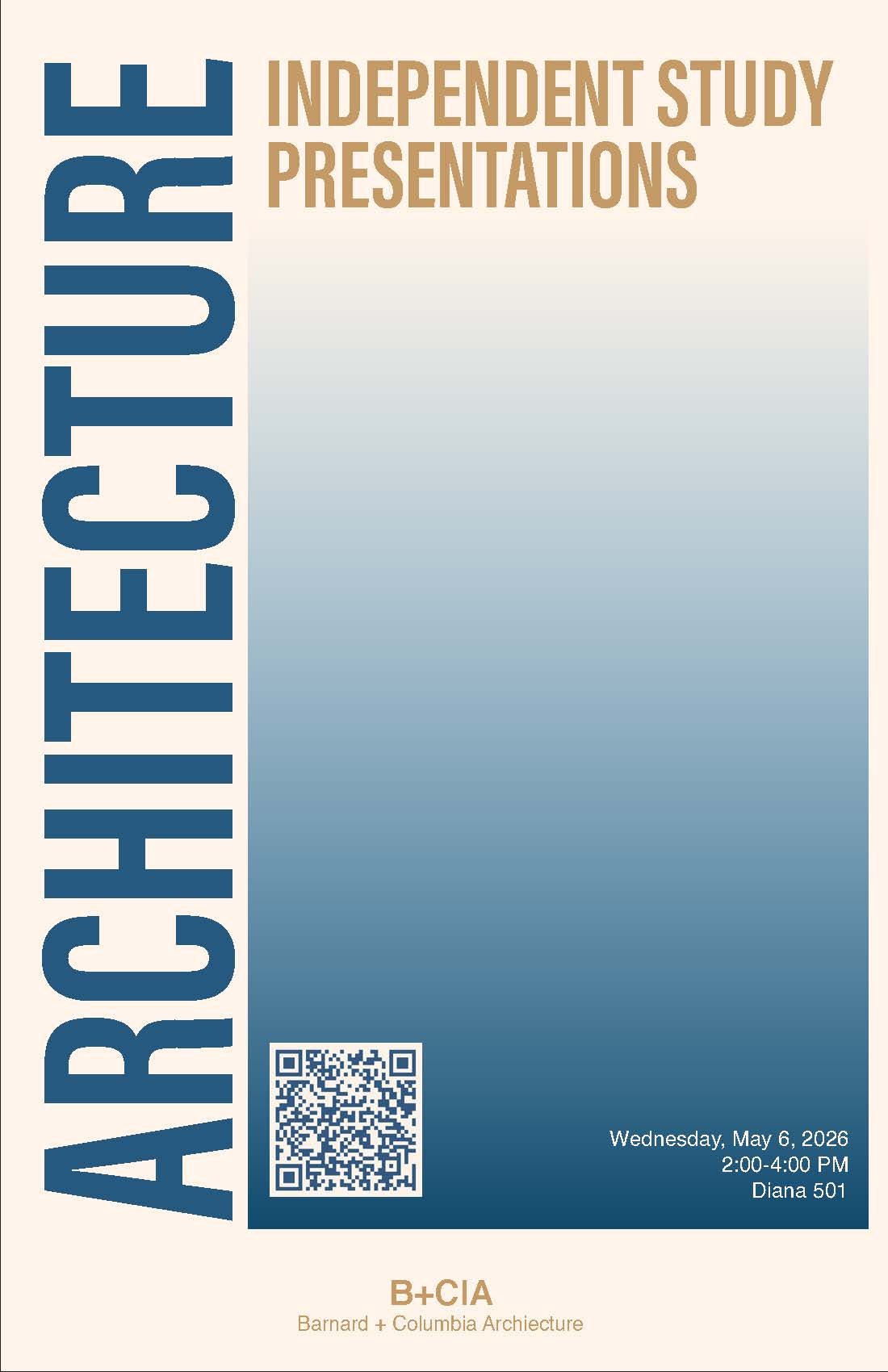
 

The Spring 2026 Architecture Independent Study Presentations Poster